Must-See Masterpieces at the Van Gogh Museum


Blogs
The Natural History Museum does not ease you in. You arrive on Cromwell Road in South Kensington, and the building makes its case before you step inside. Alfred Waterhouse designed this place in 1881 as a kind of cathedral to the natural world. It is now the most visited attraction in the UK — 7.1 million people in 2025 — and most of them walked straight past the carvings on their way to the dinosaurs.
Slow down. The western wing is covered with reliefs of living species: monkeys scaling the arches near the main entrance, birds perched along the ledges. Cross into the eastern wing, and the living give way to the extinct — pterosaurs crouching along the roofline, ancient sea creatures winding through the stonework. The shift is on purpose and unmarked. Waterhouse built the story of extinction and survival into the walls before a single display case was put in place.
Inside, eighty million objects span 4.5 billion years of Earth's history. The permanent galleries are free. The museum employs over three hundred working scientists. And what sets this museum apart from others like it is the belief that science and storytelling belong together. Every major gallery is built to raise a question, not just show a label. That instinct makes a first visit as rewarding as a fifth. Whether you explore on your own or book a guided tour of the Natural History Museum of London, the building rewards those who pay close attention.
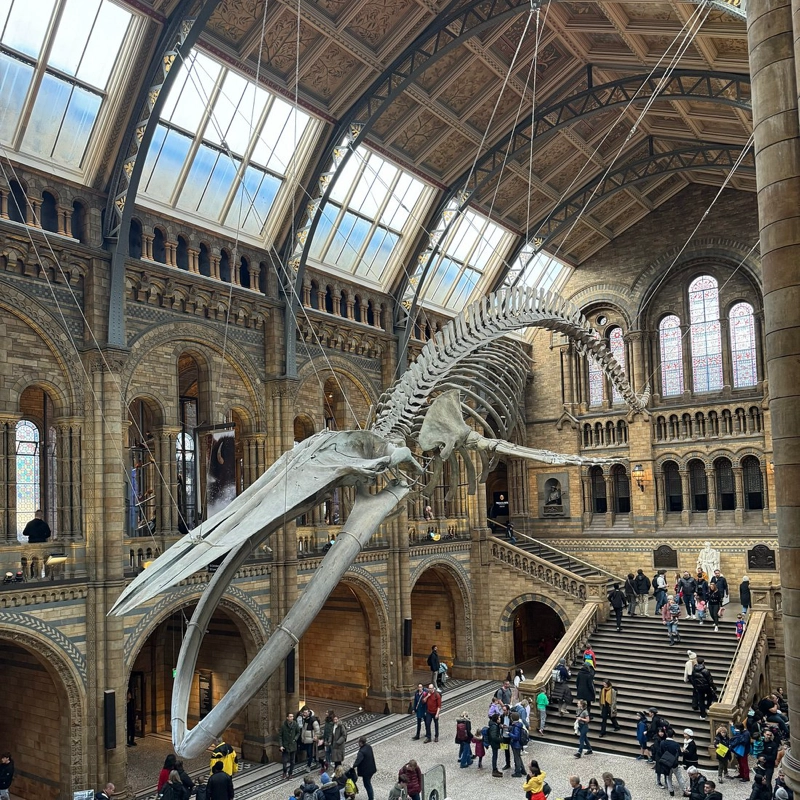
Entering Hintze Hall is one of those rare museum moments where the room itself stops you mid-stride. Your eyes are pulled upward to Hope — a 25.2-metre blue whale skeleton hung from the Victorian iron roof beams in a diving pose. She is the only blue whale skeleton in the world mounted this way.
Hope replaced Dippy, a plaster cast of a Diplodocus that had stood in the hall since 1979. The swap, finished in July 2017, was not a popular move with everyone. But the thinking behind it was sharp. Dippy stood for a love of the safely extinct. Hope stands for something more urgent. Blue whales were hunted from roughly 250,000 down to perhaps 400 by 1966. That year, in London, the world chose to protect them by law. Their numbers have since climbed back to around 20,000. The museum's central message shifted from "look at what once existed" to "look at what we nearly lost."
The whale herself was a young female who washed ashore in Wexford Harbour, Ireland, in March 1891 — just ten years after the museum opened. Her skeleton was bought by the museum, first shown in the Mammal Hall in 1934, and spent decades there in relative quiet before her striking new pose. But Hope is not the only thing worth seeing in this room. The ceiling holds 162 hand-painted plant panels, designed by Waterhouse and painted by Charles James Lea of Manchester in 1881. Of these, 108 show plant species chosen for their role in Victorian Britain and its empire: cotton, tobacco, opium poppies, English oaks. Most visitors never look up past the whale. Around the hall, the Wonder Bays house rotating star pieces. The statue of Charles Darwin on the main staircase puts you roughly at eye level with Hope's jawbone — the best single viewpoint in the whole museum.
Guide's Note:
The museum was designed as a "cathedral to the natural world" where instead of saints and biblical scenes, you’ll find animals and wildlife depicted throughout. The detail is absolutely amazing and once you see it you cannot unsee it because they're everywhere. For me, it truly is the "cherry on top" of the entire museum experience.
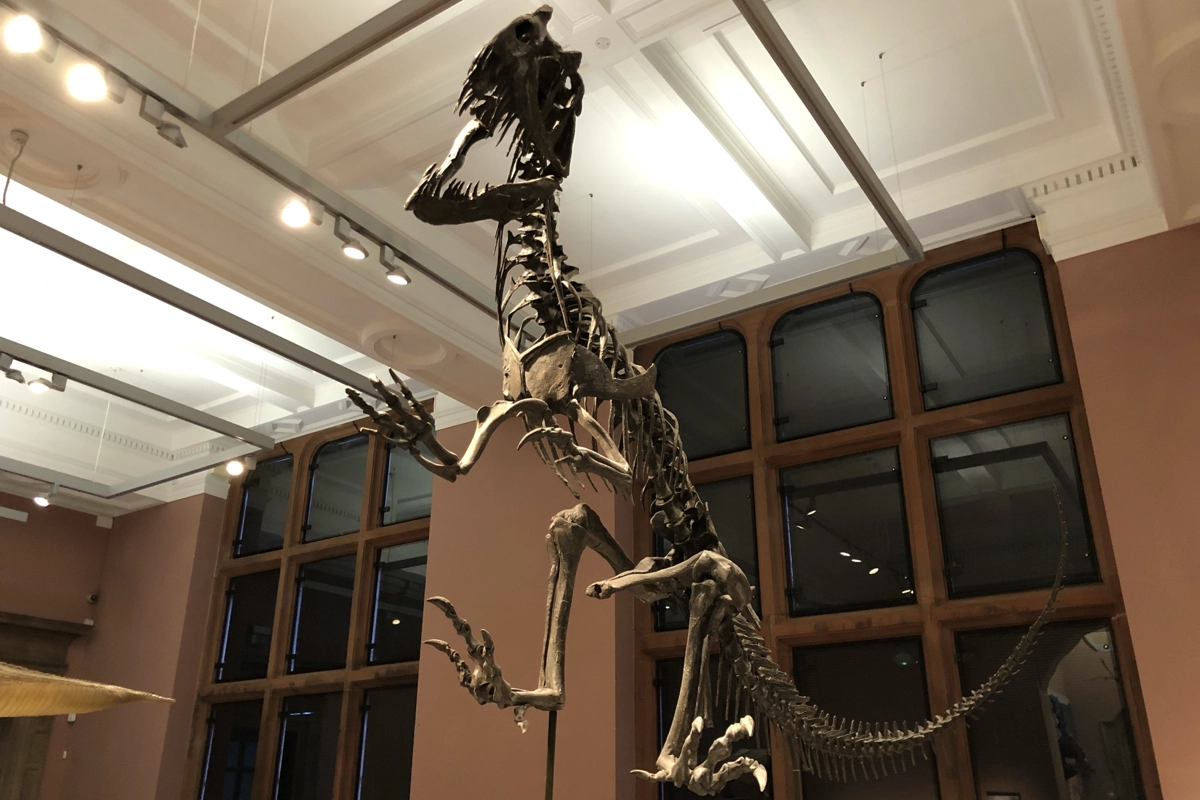
The Blue Zone's Dinosaur Gallery is the museum's most famous section, and it earns that name. Its approach tells a story rather than sorting fossils into groups — walking visitors through the age of the dinosaurs instead of laying them out as a fixed display.
The moving T. rex draws the biggest crowds and the loudest shrieks. It is pure theatre. But the gallery's real weight lies elsewhere, in the actual fossils that most visitors hurry past. Richard Owen, the museum's first head, coined the word Dinosauria in 1842 using three groups — Megalosaurus, Iguanodon, and Hylaeosaurus. Specimens tied to all three exist within these walls. That makes this one of the few places on Earth where you can stand beside the fossils that launched an entire field of science.
The Baryonyx walkeri skeleton deserves a closer look. Found in a Surrey clay pit in 1983 by amateur fossil hunter William Walker, it was the first large meat-eating dinosaur found in England in over a hundred years. Its long snout and huge thumb claw point to a fish-eating way of life unlike any dinosaur known before it. (Nearby, Sophie the Stegosaurus is one of the most complete of her kind in the world, with over eighty percent of her bones present. She has been CT-scanned to create the most detailed 3D model of any Stegosaurus, shedding new light on brain size and how she moved. These are not side shows.) - They are the reason the gallery matters.
Guide's Note:
For me, one of the coolest fossils has to be the small and unassuming Coelophysis (mounted on the wall to your left, just before you reach the large Triceratops). If you look closely, you can see the contents of its last meal, bones preserved beneath the ribcage.
Initially it was argued that these might be the remains of a young Coelophysis, suggesting cannibalism. But further research has shown that they actually belong to a baby or small crocodile. Discoveries like this help us better understand the diets of ancient animals, and therefore their habitats.
The Minerals gallery and the nearby Vault sit in a different part of the museum — quieter, darker, and focused on rocks and gems rather than living things. The gallery itself is a window into how the Victorians liked to sort the world: raw specimens in the same wooden cases, grouped by what they are made of. It has the feel of a working library.
The Vault, at its far end, is something else. This small, dimly lit, guarded room holds the museum's rare gems, precious metals, and pieces of meteorite. It is compact enough to see in fifteen minutes and packed enough to reward much longer. The Aurora Pyramid of Hope — 296 natural diamonds in every colour you can think of — is the star piece. The Devonshire Emerald is one of the largest uncut emeralds ever found. The Medusa Emerald from Zambia is seen as one of the world's finest mineral pieces. The Tissint meteorite landed in Morocco in 2011 after a 700,000-year trip from Mars — a real piece of another planet you can see up close. And the Delhi Purple Sapphire — really an amethyst, sometimes called the Cursed Amethyst — was given to the museum with a handwritten letter warning of its dark history. The story is as good as the stone.
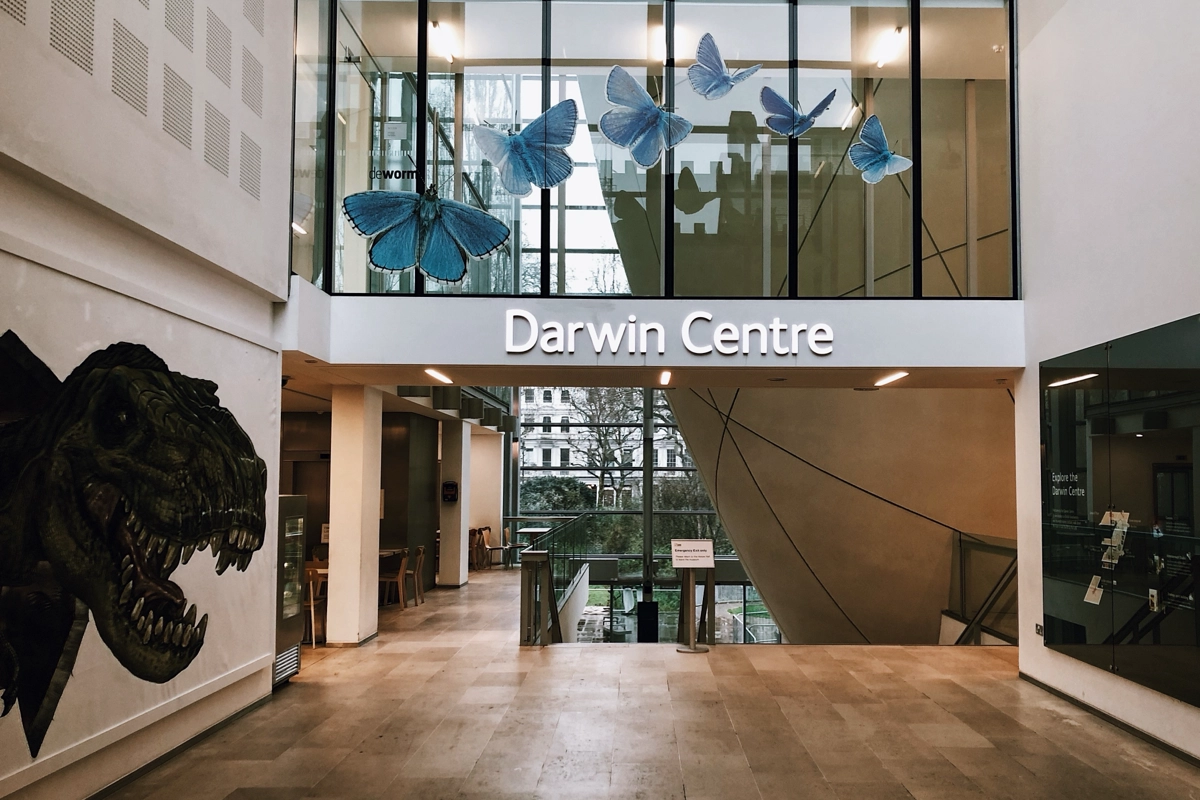
The Darwin Centre, finished in 2009, is the museum's clearest answer to a simple question: what does a natural history museum do when nobody is looking? Its central feature is the Cocoon — an eight-storey curved concrete pod sitting inside a glass hall. It is a building within a building, and a bold break from Waterhouse's Victorian design. Inside, the Cocoon takes visitors past viewing windows into working labs and storage. The Spirit Collection alone — animals kept in alcohol — fills 27 kilometres of shelving and holds over 22 million items. Some date to the museum's earliest years. Others arrived last week.
Glass-walled labs let you watch scientists at work in real time. The Attenborough Studio hosts regular free talks by its scientists on topics from deep-sea life to parasites. At times, you can ask the experts questions directly — a feature that sounds like a gimmick but is, in practice, one of the most lasting parts of any visit.
The dinosaurs and the blue whale are the headliners. But the Natural History Museum is vast — over four zones and dozens of galleries. Several of its quieter rooms hold specimens just as striking as anything in the main halls, with a fraction of the crowd. If you have time for only one detour, make it the Treasures Gallery. If you have two, add the Fossil Marine Reptiles.
The gallery sits in the Cadogan wing, at the top of the Hintze Hall staircase. It is a masterclass in what one room can do. Twenty-two key objects spanning 4.5 billion years. A first edition of Darwin's On the Origin of Species. The Iguanodon teeth found in Sussex in 1822 — the fossils that helped launch the study of ancient life. A piece of the Moon. The skeleton of Guy the Gorilla. The room is small enough to see in ten minutes and rich enough to hold you for an hour. It is the whole museum in one room.
This gallery is ruled by ichthyosaur and plesiosaur skeletons — huge sea hunters that roamed the oceans while dinosaurs walked the land. Many were found along the Jurassic Coast of Dorset by Mary Anning, born in 1799. She is one of the most important figures in early fossil science. Anning was the daughter of a Lyme Regis cabinet maker. She found the first rightly named ichthyosaur skeleton, the first complete plesiosaur, and key pterosaur finds — all without formal training, backing, or proper credit. Her work challenged the thinking of her time, when the very idea of extinction was still in dispute. Standing in front of her finds brings you closer to the hard fieldwork behind them. The cliffs were unstable. Winter storms exposed new layers of rock. And the social barriers of the era kept a working-class woman out of the science journals.
Guide's Note:
Not necessarily a "Mary Anning specimen" but there is a cool fossil of an ichthyosaurus mum with babies inside her. This proved to us that ichthyosaurus were viviparous and gave birth to live babies. This feature is not common in most reptiles today, but it helped ichthyosaurus survive in the marine environment by removing the need to lay eggs on land.
The Wildlife Garden sits behind the main building. It brings together a mix of British habitats — woodland, meadow, hedgerow, and pond — and is home to over 3,000 species in central London. Depending on the season, you might spot damselflies over the water in summer, hedgehogs in autumn, or the first blackthorn blossom in spring. After hours inside galleries of preserved finds, stepping into a space where living nature is clearly at work feels like a reset.
The main galleries are free, but you must book a timed entry ticket online through the museum's website. This system was brought in during the pandemic and kept since. Booking is free and simple, but during peak times slots fill up. Book at least a few days ahead. The museum opens daily at 10:00 AM and closes at 17:50. A visit covering the major highlights takes three to four hours. A full visit with the Darwin Centre and Wildlife Garden takes a whole day. If visiting with young children, allow extra time — the Dinosaur Gallery will absorb it.
90 Minutes: Enter via Cromwell Road. Hintze Hall, then the Dinosaur Gallery, then the Treasures gallery. Three displays, one clear route. Half Day (3–4 Hours): Add Earth's Treasury, the Vault, and the Fossil Marine Reptiles gallery. Finish with the Darwin Centre Cocoon. Full Day with Children: Dinosaur Gallery first at opening before crowds build. Late morning: Human Biology and Creepy Crawlies. After lunch, the Wildlife Garden. Afternoon: the Darwin Centre, then Hintze Hall as crowds thin.
The museum is busiest during UK school holidays and weekends, with the peak between 11:00 AM and 2:00 PM. For the quietest time, come on a Tuesday, Wednesday, or Thursday morning right at opening, or arrive after 3:00 PM. Avoid the Dinosaur Gallery at midday during school holidays unless you enjoy standing in a queue that barely moves.
The Natural History Museum is, at its core, an argument. It has been building since Waterhouse carved extinct species into the eastern wing and living ones into the west. The claim is simple: the natural world is not a backdrop to human history. It is the subject of a longer, stranger, and far more important story. Every gallery drives that point home. The Vault holds meteorite fragments 4.5 billion years old. Overhead hangs Hope the blue whale — a species we hunted nearly to death and then, in this very city, chose to save.
The museum rewards the visitor who slows down. Read the label beneath the Baryonyx as closely as you watch the moving T. rex. Look up past the whale to the ceiling panels carved with plants. Wander into the Fossil Marine Reptiles gallery and you might spot the name Mary Anning. These are the moments where a building full of specimens becomes a building full of stories. Stories about scientists who fought over what extinction meant. Collectors who risked their lives on the Dorset cliffs. Engineers who worked out how to hang a four-and-a-half-tonne skeleton from a Victorian roof.
What makes the museum worth coming back to is the density of those stories in every room. A solo visit gives you the specimens. A private guided tour of the Natural History Museum of London gives you the thread that ties them together: the rivalries, the secrets built into the walls, and the human dramas that make a cabinet of bones feel like a living history. However you choose to walk these halls, give the building the time it deserves. It has been making its case for nearly 150 years. The least we can do is listen.