Dutch Masterpieces at the Rijksmuseum


Blogs
The Metropolitan Museum of Art stands as one of the world's most prestigious cultural institutions, housing an extraordinary collection that spans more than 5,000 years of artistic achievement. Among its vast treasures, certain famous paintings at the Met have achieved legendary status, drawing millions of visitors who come specifically to experience these masterpieces firsthand. These eight exceptional works represent the pinnacle of artistic excellence, each offering unique insights into different periods, styles, and cultural movements that have shaped our understanding of art history.
From Van Gogh's emotionally charged self-portraits to Vermeer's luminous domestic scenes, these artworks at the Met showcase the museum's commitment to preserving and presenting humanity's greatest creative achievements. Together they form a core part of the famous art at the Met—works often listed among the best things to see at the Met and frequently highlighted on “must-see” itineraries.
Visiting the Metropolitan Museum of Art and its most celebrated paintings is as much about logistics as it is about appreciation. Because these paintings at the Met are distributed across a sprawling floor plan, a bit of strategic planning will enrich your experience.
Vincent van Gogh’s Self-Portrait with Straw Hat (1887) stands among the most psychologically revealing self-portraits in Western art. Created during his transformative Paris period, the painting captures a pivotal moment as the artist absorbed Impressionist influences and simultaneously developed his distinctive Post-Impressionist style. His intense gaze and the tactile brushwork convey a haunting introspection that continues to captivate viewers.
The work’s presence in the Metropolitan Museum of Art‘s collection, secured through a notable bequest, ensures public access to this profoundly human portrayal of artistic struggle and innovation. Displayed in Gallery 825, the painting often attracts large crowds. The optimal viewing distance—approximately six feet—allows for close examination of Van Gogh’s signature impasto technique and use of contrasting color.
Van Gogh’s Self-Portrait with Straw Hat exemplifies the technical and emotional evolution of his mature style. His expressive brushwork and thick application of paint—applied in bold, swirling strokes—create a textured surface that reflects not only his physical technique but also his psychological intensity. The straw hat’s vibrant oranges set against a cool blue background demonstrate his use of complementary colors to heighten visual tension and energy within the composition.
This interplay of warm and cool tones is not merely aesthetic; it serves as a window into Van Gogh’s inner world. The vivid yellows and oranges suggest vitality and light, while the muted clothing and somber background hint at restraint and introspection. This chromatic duality—radiance layered over emotional turbulence—reveals a complex emotional landscape. Through color, Van Gogh conveyed more than likeness; he offered a portrait of the self in flux, shaped by the mental and emotional currents of a profoundly creative yet unsettled life.
| Guide Note |
|
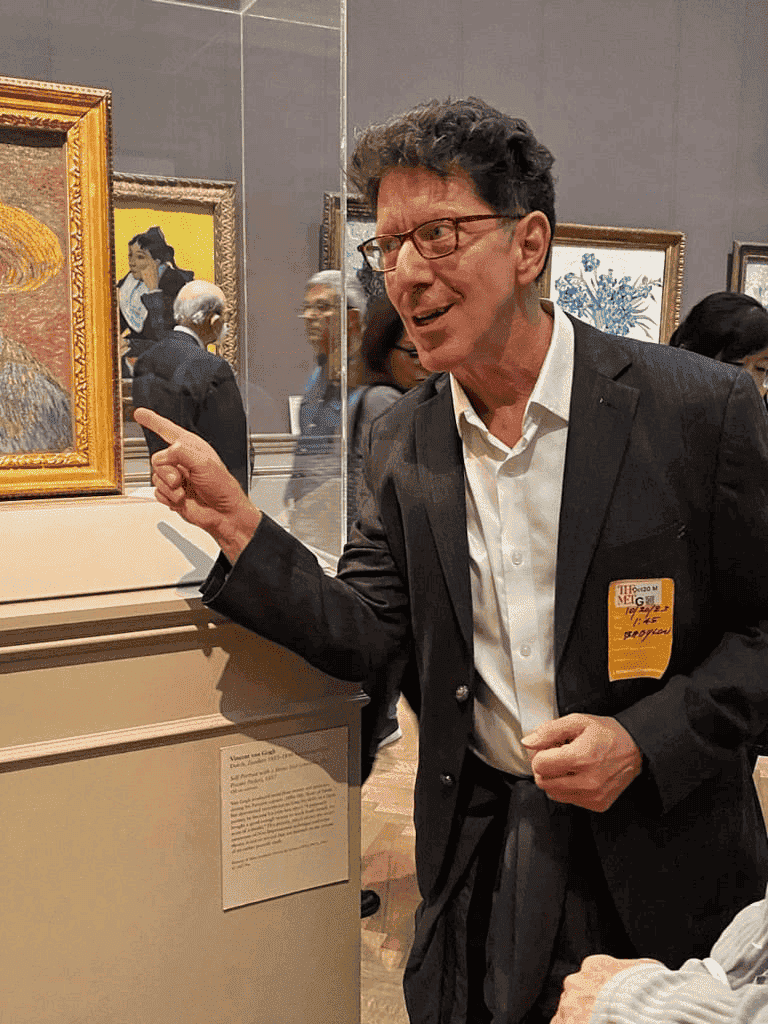
Whatever religion you believe in (remember Vincent began his scholarly life in the Seminary) please say a prayer that he sees the multitudes in front of his Self Portrait with Straw Hat. More photographed than Elvis, this is NYC's Mona Lisa. Up close, note the dance between Vincent's brushstrokes- Swirling chaos, then harnessed into a circular order. Every self portrait contains van Gogh's fight to unify his brain hemispheres. The brushstrokes tell the greater story. Just below the brim, notice the ferocious orange and blue brushstrokes vividly painted up against each other. No other Impressionist is this aggressive or innovative, ultimately, recreating the sun passing through Vinvent's straw hat brim and landing upon his upper forehead. |
Monet’s Water Lilies paintings in the Metropolitan Museum of Art offer an intimate look at the artist’s late-career experimentation, capturing moments from a series he revisited obsessively in his garden at Giverny. While Paris’s Musée d’Orsay presents a more expansive selection that traces the full arc of Monet’s evolving approach, the Met’s examples stand out for their quiet focus—inviting close, contemplative viewing rather than sweeping immersion.
Painted during Monet’s later years, these works reflect his growing interest in abstraction and sensory perception. The compositions dissolve traditional spatial cues, encouraging viewers to engage with color, movement, and reflection rather than narrative or setting. Seen in the Met’s galleries, the paintings feel personal and restrained, offering a pause amid the museum’s broader collection of European masterpieces.
From a respectful viewing distance, subtle shifts in tone and texture begin to emerge. Monet’s brushwork—sometimes dense and rhythmic, sometimes barely suggested—creates optical effects that change as you move, making each encounter slightly different. This sense of variability mirrors the natural subject itself, where water and light are never static.
In the Water Lilies series, Monet moved decisively away from precise representation, favoring sensation over description. Rather than delineating individual flowers or leaves, he layered adjacent hues and loose strokes, allowing the viewer’s eye to complete the image. The result is a surface that appears to shimmer, capturing not a single moment but an ongoing experience of light and reflection.
At the Met, this approach feels especially contemplative. Without the monumental scale of the panoramic installations found elsewhere, visitors can study how Monet built depth through repetition and variation—cool blues settling into muted greens, soft highlights drifting across the canvas. These paintings function less as depictions of a garden and more as studies in perception, revealing why Monet’s late work proved so influential for modern art.
Guide NoteAlways remember to make eye contact with the Security Officer in any particular gallery, place your hands behind your back and then be amazed, and delighted, how much closer you can get to the art.
Please still maintain at least 20 feet distance, but upon closer examination (as Monet would have wanted us to) notice the layering of textures, the build up of colored textures; you'll think you're viewing art from the 1990s.
Look for textural evidence of sand mixed into the Maestro's thick oils to create the actual experience of gravel. For every bloom Monet painted, an actual growing element from nature would have been present in his gardens, just as layered and thought-out, as his large Water Lily canvases.
Leutze’s Washington Crossing the Delaware (1851) remains one of the most iconic historical paintings in American art. Though painted in Germany, its subject—the pivotal Revolutionary War moment when Washington led his troops across the Delaware River—resonated strongly with 19th-century American ideals of heroism and national identity.
The painting’s grand scale and theatrical lighting amplify its emotional power. Surrounding works in the American Wing provide valuable context for understanding Leutze’s contribution to the development of American visual culture.
Leutze employed artistic liberties to enhance the narrative’s symbolic impact. The oversized flag and exaggerated river conditions are not historically accurate, but serve to underscore the bravery and resolve of Washington and his troops. The composition, with its diagonal thrust and illuminated central figure, draws the viewer’s eye and reinforces the work’s central message of leadership in adversity.
The painting’s reception has evolved over time—from patriotic celebration to a more critical appreciation of its artistic merit. This shift mirrors changing perspectives on the role of mythmaking in historical art.
Guide NoteGadzooks! Is this cinema scale painting a colossal failure? It is riddled with inaccuracies! Can you find the multiple horses balancing within in row boat? Those boats must have been quite the American construction, because the same rowboats are also carrying iron cannon across The Delaware.
Things to look out for:
- Find the enormous cannon wheels.
- Where is the North Star? Did our Soon to be President need a North Star to navigate across the most narrow section of that river?
- For a bonus, who is wearing the Tam o' Shanter?
Caravaggio’s The Musicians (c. 1597) reveals the artist’s early commitment to naturalism and psychological realism. The scene, populated by youthful figures preparing for a performance, blends portraiture with allegory and reflects Caravaggio’s innovative use of live models and dramatic lighting.
The painting’s emotional depth is amplified by Caravaggio’s pioneering chiaroscuro technique. A strong light source highlights faces, fabrics, and instruments, guiding the viewer’s focus while obscuring peripheral details. This interplay between light and shadow lends a sense of immediacy and intimacy.
The figures’ subtle expressions and lifelike gestures reveal Caravaggio’s rejection of classical idealization in favor of capturing the human experience with raw honesty.
Beyond these curated highlights, the Metropolitan Museum of Art offers an immersive journey through the global history of human creativity. Its vast holdings invite not only admiration, but contemplation and curiosity.
Visitors planning to return—or those who seek a deeper relationship with the institution—may consider membership. Benefits include priority access, previews of new exhibitions, and insights into conservation projects that shape the museum’s evolving legacy.
Behind-the-scenes conservation tours, offered periodically, reveal the technical mastery involved in preserving these cultural touchstones. These experiences provide a rare glimpse into the science and stewardship behind the art.
While the featured paintings represent some of the Met’s most iconic holdings, the surrounding galleries are filled with unexpected treasures. Each visit offers a new conversation—with history, with art, and with yourself. What begins as a tour of masterworks may well become the start of a lifelong engagement with one of the world’s great cultural institutions, the Metropolitan Museum of Art.