Top 5 Castles to Explore in the Netherlands

Blogs
The Musée d’Orsay in Paris houses one of the world’s most remarkable collections of 19th- and early 20th-century art. Inside its transformed Beaux-Arts railway station, visitors encounter many of the most famous paintings in Paris, including masterpieces that shaped the Impressionist and Post-Impressionist movements. The museum traces a sweeping artistic evolution—from Realism to Symbolism, from the birth of Impressionism to the earliest steps toward abstraction.
What makes the Orsay unforgettable is the way architecture and art work together. Sunlight pours through the iron-and-glass canopy, marble sculptures stand beneath the massive station clock, and the galleries shift from intimate studies to soaring cathedral-like spaces. For anyone exploring famous paintings in the Musée d’Orsay, the building itself becomes part of the story.
If you’re planning a visit to Paris → (https://babylontours.com/paris/) and want a quick guide to the museum’s most iconic works, the following masterpieces are the perfect place to begin. Each represents a major moment in modern art—and all are located along a simple, visitor-friendly route you can walk in under an hour.
1. Starry Night Over the Rhône — Vincent van Gogh (1888)
One of Van Gogh’s most poetic night scenes, known for its shimmering blue-and-gold reflections and serene composition.
Where to find it: Level 5 — Post-Impressionists
2. Water Lilies (selected panels) — Claude Monet (1900s)
Monet’s iconic study of light and atmosphere, dissolving landscape into pure reflection and color.
Where to find it: Level 5 — Impressionists
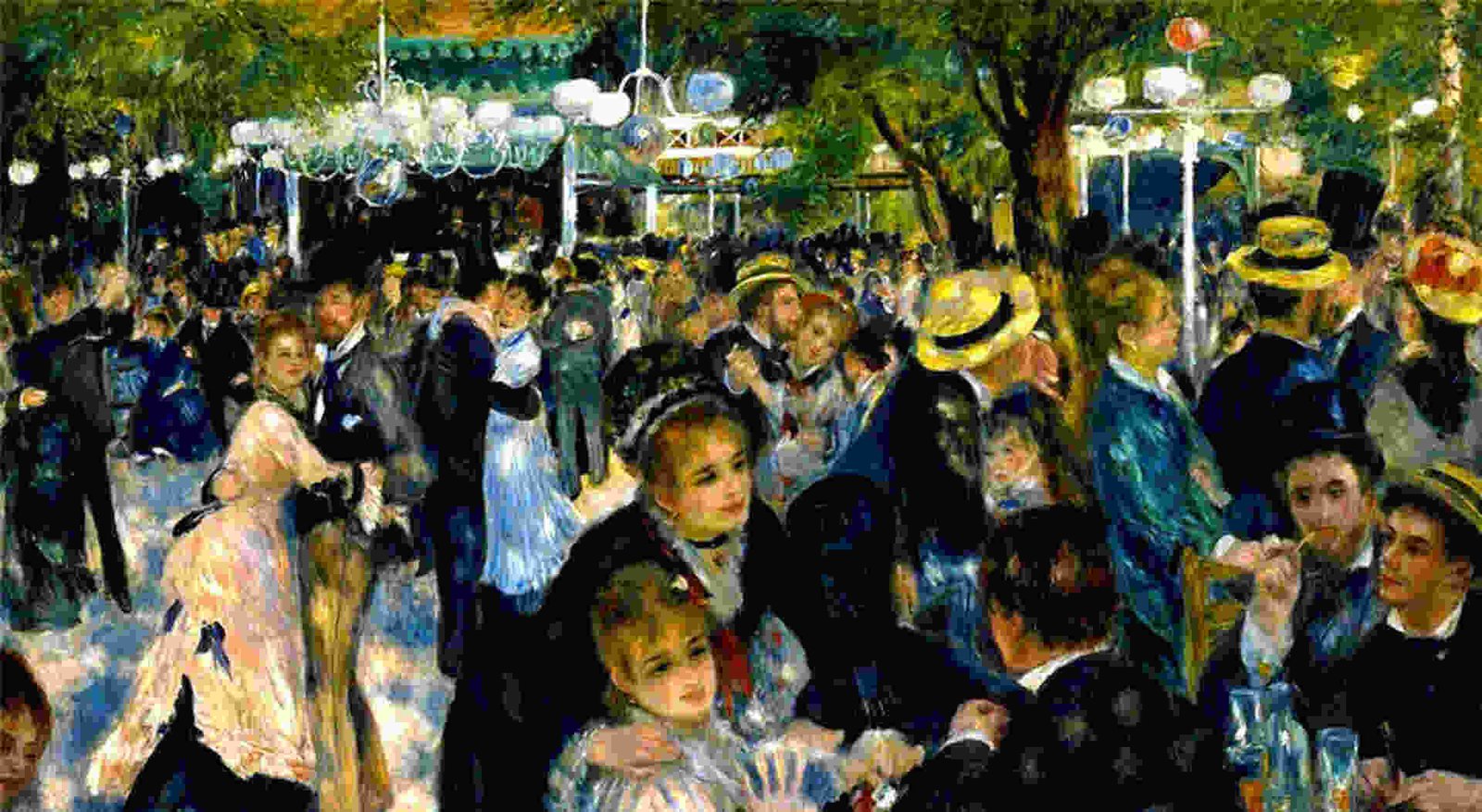
3. Dance at the Moulin de la Galette — Pierre-Auguste Renoir (1876)
A luminous snapshot of Parisian social life, filled with movement, flickering sunlight, and joyful energy.
Where to find it: Level 5 — Impressionists
For a deeper dive into these masterpieces and how they shaped modern art, you can explore them with a Musée d’Orsay Guided Tour → (https://babylontours.com/paris/orsay-museum-guided-tour/), which offers expert insights and a streamlined route through the museum’s most celebrated galleries.
Situated along the Left Bank of the Seine in the heart of Paris, the Musée d’Orsay began its life as the Gare d’Orsay, a modern marvel of the 1900 Exposition Universelle. Its steel framework was masked by classical limestone façades—industrial innovation hidden beneath artistic elegance, a duality that mirrors the museum’s collection today.
When train technology evolved and platforms became too short for newer locomotives, the station slowly fell into disuse. By the 1970s, it narrowly escaped demolition. Instead, French cultural leaders saw an opportunity: a museum dedicated to the most misunderstood, groundbreaking, and newly celebrated artists of the 19th century.
The conversion of the Gare d’Orsay into the Musée d’Orsay was a masterclass in adaptive reuse. Lead architect Gae Aulenti preserved the station’s iconic clock, barrel vaults, and sweeping sky-lit nave while redesigning the interior to showcase more than 4,000 works of art.
Where travelers once waited with suitcases, visitors now stand before masterpieces by Van Gogh, Monet, Manet, Degas, Renoir, Cézanne, Gauguin, and many others. The result is a uniquely atmospheric museum experience—one where industrial grandeur amplifies the intimacy of the world’s most beloved artworks.
Among the Musée d’Orsay famous paintings, few works offer the quiet, luminous beauty of Vincent van Gogh’s Starry Night Over the Rhône (1888). Painted during his time in Arles, this nocturne captures a moment of stillness—gas lamps shimmering across the river, stars reflected on water, and a strolling couple grounding the cosmic scene in human presence.
Where its more well-known sibling, The Starry Night, swirls with psychological turbulence, this earlier composition is calm, deliberate, and filled with hope. Van Gogh experimented here with complementary colors—especially blues and yellows—to express harmony through contrast.
Guide’s Note — Arnaud Azoulay
When I led tours through this gallery, Starry Night Over the Rhône often caught people off guard. It feels deceptively simple—almost childlike—until you realize every decision is intentional. Van Gogh managed to keep that sense of wonder alive without losing control of his craft. This was September 1888, painted in Arles before his mental collapse, before the turbulence of The Starry Night. Here, the night feels balanced and hopeful. Step a few paces back and the reflections on the water align with the couple on the riverbank. The faint church spire in the distance, often missed, anchors the emotion in quiet faith. That’s what I love about this piece: it’s Van Gogh before the storm—light still winning.
What to Notice
The faint church spire—his subtle reminder of order in chaos.
Claude Monet’s Water Lilies are among the most famous paintings in the Musée d’Orsay, and although the most panoramic versions reside at the Musée de l’Orangerie, the Orsay collection reveals the evolution of Monet’s lifelong study of light, water, and atmosphere.
Created in Giverny between the 1890s and 1920s, these works showcase Monet’s shift toward increasingly abstract compositions. He eliminated the horizon line, allowing the sky and water to merge into a single floating world of color. What appears effortless is actually the result of obsessive revision—layered brushstrokes, scraped patches of canvas, shifts in palette, and dozens of experimental canvases exploring the same motif.
In the Orsay’s quieter gallery spaces, visitors can stand close to the surface and see Monet’s process laid bare: deep blues layered with lavender, pale greens dissolving into silver, gold strokes catching imagined sunlight. These are less landscapes and more meditations—cathedrals built from water and color.
Guide’s Note — Arnaud Azoulay
I often tell visitors Monet painted cathedrals made of water. The Orsay’s Water Lilies aren’t the huge panoramic panels from the Orangerie; they’re more intimate, more revealing. Stand close and look across the surface rather than straight at it—suddenly, color becomes architecture. The natural skylight above changes everything: cool silver in the morning, warm gold by late afternoon. Monet worked on these in Giverny, repeating them like prayer until he reached the right light. The comparison to his Rouen Cathedral series isn’t accidental—both are acts of devotion, chasing revelation through repetition. What looks spontaneous is actually precision built on obsession. That’s why this room feels sacred to me.
What to Notice
James McNeill Whistler’s Arrangement in Grey and Black No. 1, better known as Whistler’s Mother, is a surprising highlight among the museum’s most famous works from the Musée d’Orsay—a serene, disciplined portrait that contrasts sharply with the color-filled Impressionist galleries nearby.
Painted in 1871, the composition is austere: the artist’s mother seated in profile, hands folded, the entire scene reduced to a refined interplay of greys and blacks. Whistler emphasized balance over narrative, calling it an “arrangement” to focus attention on harmony, geometry, and tone.
Rejected by the Royal Academy in London, the painting later gained recognition in France and became an enduring symbol of maternal dignity. Its presence in Paris underscores the museum’s role not only as a home for French masters but as a keeper of international works that reshaped modern art.
Guide’s Note — Arnaud Azoulay
This is where the tempo changes. After all the color upstairs, Whistler’s Mother reads like silence. I’ve watched countless visitors double-take when they realize it’s by an American artist, rejected in London and later celebrated here in Paris. Whistler called it an “arrangement” to emphasize design over subject. From slightly left of center, the curtain’s damask pattern breaks the austerity and balances the verticals. Her folded hands aren’t relaxed—they hold quiet discipline. This painting proves that modern art began not just with rebellion, but also with restraint. It’s serenity earned through control, not passivity.
What to Notice
Pierre-Auguste Renoir’s Dance at the Moulin de la Galette (1876) is one of the most joyful and immersive famous paintings in the Musée d’Orsay. Set in the Montmartre dance garden of the same name, the painting captures a Sunday afternoon filled with movement, flickering sunlight, and the hum of Parisian social life.
Renoir painted among the crowd, not from a distance, allowing him to document friends, models, and neighbors with warmth and immediacy. His quick brushwork and layered color create a sense of motion—the blur of a turning head, shifting shadows, circles of light filtering through the acacia trees.
This scene is more than entertainment; it’s a snapshot of working-class leisure in a rapidly modernizing Paris, and a testament to Renoir’s belief that beauty was found in shared moments.
Guide’s Note — Arnaud Azoulay
Few paintings capture joy as sincerely as Renoir’s Dance at the Moulin de la Galette. When I bring people to this room, I ask them to imagine the late afternoon air in Montmartre—the sound of music, the smell of wine, the sunlight flickering through trees. Painted in 1876, this is a record of real friends and real moments. Renoir worked within the crowd, not apart from it, which is why the scene feels alive rather than posed. From slightly right of center, the flicker of dappled light becomes rhythmic; the brushwork feels almost cinematic. Renoir wasn’t idealizing Paris—he was preserving it in motion.
What to Notice
With more than three million visitors each year, the Musée d’Orsay can feel especially crowded around its Impressionist galleries. Planning your visit around peak-flow patterns can dramatically improve your experience—and ensure you see the famous pieces at Musée d’Orsay without navigating heavy foot traffic.
Aim to build a route that starts with the upper-level galleries (Level 5) before they reach their late-morning peak. This is where you’ll find Van Gogh, Monet, Gauguin, and Cézanne under the museum’s iconic glass canopy.
Recommended Visit Times
Additional Tips
By Arnaud Azoulay
If you’re visiting independently and primarily interested in Impressionism, morning is best. Begin on Level 5, where Van Gogh, Monet, and Renoir are displayed under the great glass ceiling before the space fills. Then drift down through Symbolism and finish in the sculpture hall beneath the clock. The light shifts as you descend—it’s like moving through time. The café clock overlooking Sacré-Cœur still offers the cleanest photo spot without blocking others.
On my guided tours, though, I prefer to lead visitors chronologically—starting on the lower levels with Courbet, Millet, and early Realists before rising to the Impressionists and Post-Impressionists. That sequence gives meaning to the evolution you see upstairs: how industrial progress, politics, and philosophy transformed art from rigid storytelling into pure experience. It’s the most rewarding way to understand what the Orsay—and modern art itself—represents.
For visitors seeking deeper context or a curated route through the museum’s most famous works, the Musée d’Orsay Guided Tour → (https://babylontours.com/paris/orsay-museum-guided-tour/) offers expert insights that bring each gallery to life through story, technique, and history.